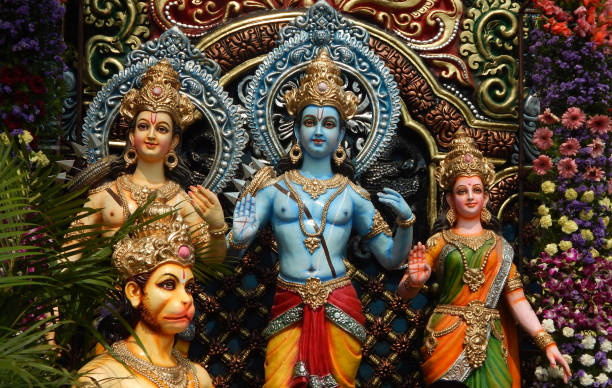
Ramanavami is a Hindu festival that honors the birth of Rama, who is one of the most widely venerated deities in Hinduism and regarded as the seventh avatar of Vishnu. In Hinduism, he exemplifies the ideal king and human being through his adherence to righteousness, moral conduct, and virtue. The festival takes place on the ninth day of the waxing phase of the lunar month of Chaitra (from March to April), which is the initial month in the Hindu calendar. It is also a part of the Chaitra Navaratri festival that occurs in the spring.
Certain devotees celebrate Rama by treating him as a baby, placing a depiction of him in a cradle. Community meals and charitable events are also held. For many Hindus, the festival serves as a time for ethical contemplation.
On this day, celebrations are held at Ayodhya’s Ram Mandir as well as various Rama temples throughout India. Ratha yatras featuring Rama, Sita, Lakshmana, and Hanuman are held in numerous locations. In Ayodhya, many individuals take a dip in the holy Sarayu River before visiting the Rama temple.
Information about Rama’s birth is described in Valmiki’s Ramayana and the Mahabharata. As indicated, Rama was born to King Dasharatha and Queen Kausalya in the city of Ayodhya.
CELEBRATIONS AND RITUALS
Several cities referenced in the legends of the Ramayana related to Rama’s life host significant festivities. Among these cities are Ayodhya, Rameswaram, Bhadrachalam, and Sitamarhi.
The customs and celebrations linked to Rama Navami differ from one region to another across India. Local mandalis and neighborhoods observe Rama Navami by distributing free panakam and some food.
LITERATURE
Ramanavami involves engaging with literature about Rama, either through reading or listening. A tradition is to read the Ramayana for a week prior to Rama Navami. Rama Navami is celebrated twice a year, once during Chaitra Navaratri and again during Sharad Navratri.
Ramanavami involves engaging with literature about Rama, either through reading or listening. A tradition is to read the Ramayana for a week prior to Rama Navami. Rama Navami is celebrated twice a year, once during Chaitra Navaratri and again during Sharad Navratri.
HERE’S A MORE DETAILED EXPLANATION:
Chaitra Navratri celebrated:
This Navratri, which takes place in September or October, also features Rama Navami on the ninth day, signifying the conclusion of the festival.
Sharad Navratri
This Navratri, which takes place in September or October, also features Rama Navami on the ninth day, signifying the conclusion of the festival.
RAM NAVAMI SIGNIFICANCE AND SYMBOLISM:
Ram Navami carries deep meaning and significance in Hinduism, as the birth of Lord Rama represents the triumph of righteousness and dharma over adharma. It acts as a reminder of the necessity of maintaining moral values, honoring one’s obligations and responsibilities, and standing against wrongdoing and oppression.
The festival also marks the arrival of spring, a time associated with renewal, growth, and abundance. Much like how the earth flourishes with fresh life in spring, Ram Navami revitalizes the spirit of the devotees, uplifting their hearts with hope and joy.
Ram Navami encourages unity and harmony among individuals from various communities and backgrounds. No matter their caste, creed, or nationality, devotees unite to celebrate the universal principles of love, compassion, and righteousness that Lord Rama represents.
Conclusion :
Rama Navami is an important Hindu festival that commemorates the birth of Lord Rama, representing righteousness, devotion, and the triumph of good over evil. This occasion provides an opportunity for spiritual contemplation, prayers, community festivities, and acts of kindness.
 vividlife
Leave a comment